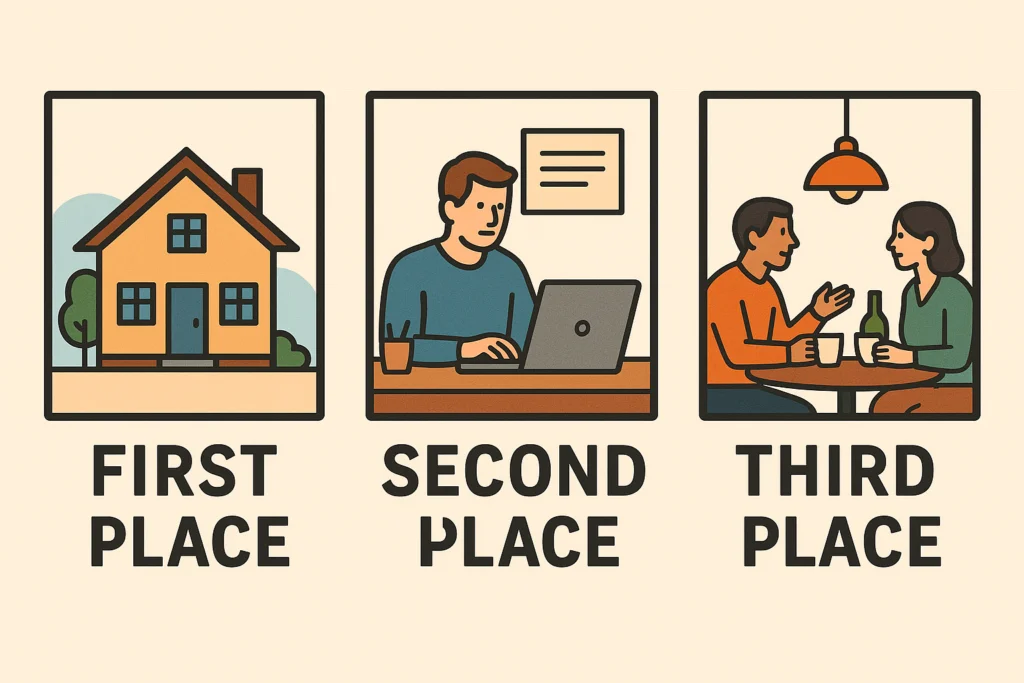
In an era defined by digital connectivity and physical isolation, the concept of community feels more elusive than ever. While we scroll through social media feeds and send messages to friends across the globe, we often find ourselves disconnected from the neighbors living just a few doors down. This paradox of modern life has prompted a renewed interest in a sociological concept that might hold the key to rebuilding the social fabric of our neighborhoods: the “third place.” These sanctuaries, separate from the first place of home and the second place of work, are the vibrant community hubs where people gather, connect, and build the social capital essential for a thriving society .
Understanding the Third Place Concept
The term “third place” was first popularized by American sociologist Ray Oldenburg in his influential 1989 book, The Great Good Place: Cafes, Coffee Shops, Bookstores, Bars, Hair Salons, and Other Hangouts at the Heart of a Community . Oldenburg argued that a healthy society requires more than just functional homes and productive workplaces. It needs accessible, neutral grounds where individuals from all walks of life can meet, engage in conversation, and foster a sense of belonging. These third places serve as the anchors of community life, offering a vital counterbalance to the pressures and routines of our daily obligations . They are not about formal membership or obligation; rather, they are informal public gathering spots where we can relax, be ourselves, and connect with others in a meaningful way .
The third place is distinct from the public spaces we might encounter in our daily lives. Unlike a shopping mall where the primary activity is consumerism, a third place’s main currency is conversation and connection . It is a space where people can be in public but feel a sense of comfort and familiarity akin to being at home, a “home away from home” . This is a space where a corporate executive and a retiree can sit at the same table, where a teacher and a teenager can engage in a spirited debate about politics, and where the social hierarchies that define our daily lives are temporarily set aside .
The Essential Characteristics of a Third Place
Oldenburg identified several core characteristics that define a successful third place . These are not strict rules but rather common attributes that make these spaces so effective at building community.
A. Neutral Ground
These are spaces where people “may come and go as they please, in which none are required to play host, and in which all feel at home and comfortable” . There is no obligation to be there; you are a guest, not a host, free to participate or simply observe.
B. A Leveling Place
Third places are great equalizers . They set no importance on an individual’s status in society. One’s socioeconomic status, profession, or social standing does not matter. This allows for a sense of commonality among its occupants and encourages interaction between people who might not otherwise meet .
C. Conversation as the Main Activity
While activities like playing games or reading are common, the heartbeat of a third place is talk. The tone is light-hearted, humorous, and engaging. As Oldenburg notes, “nothing more clearly indicates a third place than the talk is good; that it is lively, scintillating, colorful, and engaging” . It is a forum for debate, gossip, and the sharing of news.
D. Accessibility and Accommodation
A third place must be accessible, ideally within walking distance of the homes of its regulars . It should be open and accommodating, providing for the wants of its inhabitants and making them feel welcome regardless of the time of day.
E. The Regulars
The presence of regulars is a crucial element. These are the familiar faces that give the space its identity and tone . They are the ones who make a newcomer feel welcome and draw others in. As one analysis put it, it is the regulars, not the seating capacity or the menu, that truly attract people .
F. A Low Profile
Authentic third places are typically plain, unpretentious, and without extravagance . This “low profile” discourages pretension and reinforces the leveling nature of the space. They are not fancy or expensive, making them accessible to a wide range of people.
G. A Playful Mood
The atmosphere in a third place is generally playful. Wit, good-natured banter, and light-hearted teasing are highly valued. A serious conversation is likely to be short-lived, as the regulars will soon steer things toward a more jovial tone .
H. A Home Away from Home
Ultimately, a third place should feel like a second home, providing the same warmth, psychological comfort, and support that one expects from their own house . It is a place of regeneration and restoration, where the stresses of work and home can be temporarily set aside.
Historical Precedents and Modern Examples
While Oldenburg coined the term in the late 20th century, third places have existed for centuries. In 17th-century England, coffeehouses were known as “Penny Universities” because for the price of a cup of coffee, one could access a wealth of literary, political, and business information . These establishments were the precursors to the daily newspaper and modern stock exchanges, operating as powerful democratic forums where ideas were freely exchanged. Similarly, the English pub, the French café, and the Viennese coffee house have long served as cornerstones of social life in their respective cultures .
Today, third places take on many forms. They can be a cozy neighborhood coffee shop, a sunlit corner of a public library, a bustling community center, a barbershop, a gym, or a shaded park bench . In lower-income areas, a fast-food restaurant might serve the same vital function as a traditional pub, providing a warm, inexpensive place for retirees to meet for coffee and conversation . Even places of worship, such as mosques, have been recognized as having immense potential to function as “third spaces,” evolving from mere prayer halls into vibrant hubs for education, social services, and community life . While the physical form has changed over time, the core function remains the same: to provide a neutral ground where social bonds are formed and strengthened.
The Decline of Third Places and Its Consequences
Despite their importance, many traditional third places are in decline . Several factors contribute to this loss. Suburban sprawl and “unfunctional zoning” that separates residential areas from commercial establishments have made it difficult to create walkable, accessible gathering spots . The rise of digital entertainment and online shopping has also drawn people inward, reducing the need to leave the house for social interaction . Furthermore, the COVID-19 pandemic had a devastating impact on many of the businesses that serve as third places, forcing them to close their doors and limiting face-to-face interactions .
The consequences of this decline are significant and measurable. The loss of third places has been linked to a rise in loneliness, polarization, and a weakening of civic engagement . As one expert noted, “When third places decline, we interact less with people who are different from us. Over time, distrust grows and polarization grows with it” . Without these regular, informal interactions, social capital the networks of trust and cooperation that make communities thrive atrophies. As the American sociologist Robert Putnam documented in his seminal work Bowling Alone, shrinking social capital has negative effects on local economies, schools, volunteerism, and public trust .
Third Places as a Cure for Loneliness
The modern loneliness epidemic, which was recognized as a serious public health issue even before the pandemic, makes the creation and preservation of third places more critical than ever . Third places offer an antidote to isolation by providing a sense of routine, belonging, and shared humanity. In Singapore, for example, the “kampung spirit” of community is being revived through third places like street libraries and meditation studios . These spaces allow people to feel seen, supported, and part of something bigger than themselves.
An example of this in action is the HV Little Library in Holland Village, Singapore . Conceived during the pandemic, this community-driven library began when a resident decided to share her book collection with her neighbors. What started as a single bookshelf grew into a community hub where residents gather to exchange books and conversation, and where they actively look out for each other—even rushing out in the middle of the night to protect the books from a storm. As one founder put it, “We’re so near each other: one wall away, one floor away, one ceiling away…We needed to bring them in and support them, so they don’t feel so lonely” . This story illustrates how even a small, simple initiative can create a powerful third place that strengthens community bonds.
Reimagining and Creating Third Places

Fortunately, the decline of third places is not inevitable. Communities can take steps to revive or create new ones. A clear step-by-step framework for creating third places involves focusing on purpose, location, removing barriers, and building welcoming rhythms .
A. Start with Purpose
The first step is to identify the community’s need. Is it reducing loneliness, engaging young people, or connecting neighbors who rarely speak? Letting that purpose guide the design of the third place is essential .
B. Choose or Create a Location
Third places do not have to be elaborate. A shaded spot in a front yard, a card table on a porch, or a quiet corner of a library can all serve as third places with the right intention . The key is to choose a spot and show up there regularly.
C. Remove Barriers
The space must be visible, accessible, free or affordable, and safe . Zoning regulations that allow for mixed-use functions in residential areas are also crucial for encouraging the development of third places .
D. Signal Welcome
Small cues can make a big difference. Open seating, simple signs like “Sit here,” and shared items like puzzles or books can lower barriers and turn a location into a welcoming social space .
E. Build Rhythms, Not Events
Long-term success comes from predictability, not one-off events. A weekly coffee hour or a standing lunch meetup gives people a reason to return and builds the familiarity upon which relationships are formed .
F. Identify Regulars
A healthy third place needs connectors people who greet newcomers, invite others to join, and notice when someone is missing. These regulars give the space its identity and make it feel like a home .
G. Keep It Simple
No committees, funding, or complex planning is required. At its core, a third place needs only: a place, a time, a purpose, and a willingness to show up .
A Vision for the Future: Third Places as Sanctuaries
The vision for the future must involve the intentional cultivation of third places. These sanctuaries of community life are not just nice to have; they are essential for our collective well-being. They are the antidote to the loneliness and isolation that plague modern society. By fostering social capital, they build more resilient, healthier, and happier communities. Their revival represents a return to the fundamental human need for connection and a recognition that we are stronger together .
The concept of the third place is a powerful framework for addressing our most pressing social issues. As we grapple with increasing polarization, a loneliness epidemic, and the erosion of trust, the call to create “third-place sanctuaries” has never been more urgent. From the coffeehouses of 17th-century London to the street libraries of modern Singapore, these spaces have always been the foundation upon which strong communities are built . They represent a return to what sociologist Ray Oldenburg called the “core settings of informal public life” that are vital to a healthy and vibrant society . By rediscovering, supporting, and creating these third places, we can begin to rebuild the social fabric of our neighborhoods and create a more connected, compassionate future for everyone.